Cap Rate Example: Three Worked Calculations From Rent to Cap Rate
A cap rate example worked line by line: $4,000 a month rent on a $500,000 house, $28,892 of NOI, a 5.78% cap rate, plus the same numbers run backwards.
By the CapRateCalculator.co team
This cap rate example takes one property from gross rent all the way to a finished number: a $500,000 single-family rental leasing for $4,000 a month, which works out to a 5.78% cap rate. Net operating income is $28,892, and $28,892 divided by $500,000 is 0.0578. Below are the income lines, the expense lines, the same numbers run backwards to find value, and the places the arithmetic usually breaks.
If you want the concept before the math, what cap rate measures covers it. This page is only numbers.
The formula all three examples use
Cap rate = net operating income / price.
A capitalization rate example is the same exercise under the longer name. Two inputs and one division. Net operating income is the rent you actually collect minus the cost of running the property. Price is what you pay for it. The mortgage appears in neither input, which is why a cash buyer and a buyer with 25% down read the same cap rate on the same house.
Example 1: a $500,000 rental, every line shown
The income lines
Rent of $4,000 a month is $48,000 a year of gross rent. No property collects all of it. Allow 5% for vacancy and turnover and you keep $45,600 of collected income.
That 5% is a budget line, not a forecast. One empty month costs 8.3% of a year’s rent, so check the figure against local vacancy instead of copying it.
The expense lines
Three operating expenses carry this house.
| Line | Amount | Share of collected rent |
|---|---|---|
| Property taxes | $6,000 | 13.2% |
| Insurance | $2,500 | 5.5% |
| Maintenance, reserves, management | $8,208 | 18.0% |
| Total | $16,708 | 36.6% |
The third line is 18% of $45,600, not 18% of gross rent. It covers repairs, a management fee and money set aside for big replacements such as a roof or an HVAC unit. Skip the reserve and the cap rate looks better than the property is.
Expenses total $16,708, or 36.6% of collected income. No loan payment, no interest, no depreciation.
The cap rate
$45,600 minus $16,708 is $28,892 of net operating income.
$28,892 / $500,000 = 5.78%.
That is the entire calculation. Calculating the cap rate comes down to three verbs: collect, subtract, divide.
Example 2: the one-line version when NOI is handed to you
Brokers usually give you NOI rather than a rent roll. Then the work is a single division. Round that same property to $30,000 of NOI against a $500,000 price and the cap rate is exactly 6%.
Rounding NOI up by $1,108 moved the rate 0.22 points. A 6% and a 5.78% cap rate sound almost identical, but on price that gap is about $18,500. Use the rounded version to screen listings and the line-by-line version to write an offer.
Example 3: the same income at a lower price
Nothing about a building has to change for its cap rate to change. The price can do all of it by itself.
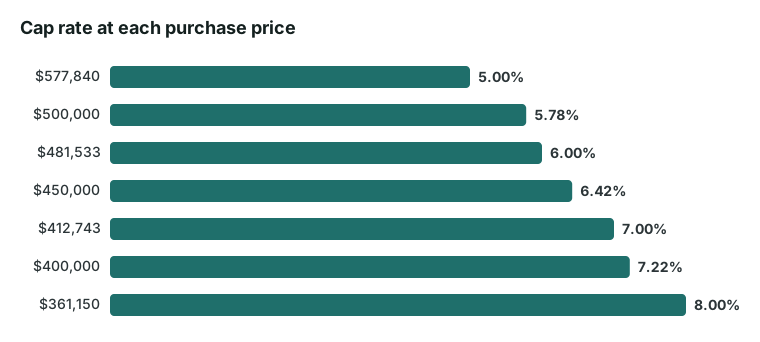
Hold NOI at $28,892 and move what you pay:
| Price | Cap rate |
|---|---|
| $577,840 | 5.00% |
| $500,000 | 5.78% |
| $481,533 | 6.00% |
| $450,000 | 6.42% |
| $412,743 | 7.00% |
| $400,000 | 7.22% |
| $361,150 | 8.00% |
Talk the $500,000 ask down to $450,000 and you have bought a 6.42% cap rate. Same roof, same tenant, same rent.
Running the examples backwards to find value
Rearrange the formula and value = NOI / cap rate. This is the version appraisers and brokers use, and it is what you reach for once you know the cap rate local comparable sales trade at.
$28,892 of NOI is worth:
- $577,840 at a 5% cap rate
- $481,533 at 6%
- $412,743 at 7%
- $361,150 at 8%
One income stream, $216,690 of spread in value. The cap rate you apply is doing more work than the rent is.
What each cap rate says about the asking price
A cap rate by itself is neither good nor bad. It is a statement about what a seller wants for a dollar of income.
Against a market trading at 6%, a 5.78% ask is roughly $18,500 high. Against a market at 5%, the seller has priced the property below what it would fetch. Against a market at 7.5%, your 5.78% usually means the rent is under market, the expenses are understated, or the sales you compared it to are not really comparable.
So every example has a second step: find the market cap rate for that property type and area. Without it, 5.78% is arithmetic with nothing to measure against.
Where the cap rate math usually goes wrong
Gross rent in place of collected rent. $48,000 divided by $500,000 is 9.6%, which is a gross yield. Vacancy and expenses have to come out first.
No reserves. Remove the capital reserve from that 18% line, NOI rises, the cap rate rises, and the roof still needs replacing. That is one of the mistakes people make with cap rate most often. A tax return is not a clean substitute either, since the IRS treats repairs and improvements differently than an operating budget does.
Debt service in the expenses. Subtract a mortgage payment and 5.78% turns into something closer to cash flow. Cap rate ignores financing on purpose.
The seller’s tax bill. The $6,000 in example 1 is the current assessment. In many places a sale resets it, so ask what the new figure will be before you trust the NOI.
List price instead of your price. The term capitalization rate means the rate at which income is turned into a price, so the price in the denominator has to be the one you actually pay.
Run your own version of these numbers
Change any line above and watch the result move. The Cap Rate Calculator on the home page takes rent, vacancy, taxes, insurance and expenses and returns NOI and cap rate, with a simple tab for when NOI is the only figure you have.
Frequently asked questions
What is a simple cap rate example?
A $500,000 house rents for $4,000 a month, or $48,000 a year. Allow 5% for vacancy and you collect $45,600. Property taxes are $6,000, insurance is $2,500, and 18% of collected rent covers maintenance, reserves and management, about $8,208. Net operating income is $28,892. Divided by $500,000, the cap rate is 5.78%.
How do you get a cap rate from monthly rent?
Multiply monthly rent by 12, take out a vacancy allowance, then subtract operating expenses to get net operating income. Divide that by the price. From $4,000 a month: $48,000 gross rent, $45,600 collected after 5% vacancy, $16,708 of expenses, $28,892 of NOI, and 5.78% on a $500,000 price. Gross rent divided by price is not a cap rate.
What does the cap rate math look like in reverse?
Value equals net operating income divided by cap rate. With $28,892 of NOI, the property is worth $577,840 at a 5% cap rate, about $481,533 at 6%, $412,743 at 7% and $361,150 at 8%. The income is identical in all four. The cap rate you apply sets the price, which is how appraisers value income property.
Why is the answer 5.78% and not 6%?
Because 6% uses a rounded NOI. A flat $30,000 of NOI on a $500,000 price is exactly 6%, and that shortcut is fine for a first screen. The full line-by-line calculation lands on $28,892, which is 5.78%. That $1,108 of NOI moves the cap rate 0.22 points and is worth about $18,500 of price.