Capitalization Rate Gordon Growth Model: Cap Rate as Discount Rate Minus Growth
The capitalization rate Gordon growth model shows cap rate equals discount rate minus growth. See the implied growth table and how to set an exit cap rate.
By the CapRateCalculator.co team
The capitalization rate Gordon growth model says a cap rate equals the discount rate minus the expected growth rate of income: cap rate = r - g. A cap rate is a required return with a growth assumption already subtracted out of it.
So a cap rate can be read as a perpetual growth formula in reverse. Buy at a 5.78% cap rate while needing an 8.5% return, and you have assumed net operating income grows about 2.7% a year forever. The income approach to valuation uses that shortcut without showing the assumption underneath it. This page shows it.
Where the Gordon growth model comes from
The model started in stock valuation. The dividend discount model values a share as the present value of every future dividend. Myron Gordon’s version added one simplifying step: assume the payment grows at a constant rate forever.
With that assumption, an infinite stream collapses into a single line.
Value = next year’s cash flow / (r - g)
Here r is the discount rate and g is the constant growth rate. The derivation and its limits are covered in the Wikipedia entry on the dividend discount model.
Real estate borrowed the same algebra. Swap dividends for net operating income and you get direct capitalization, the method appraisers and buyers use every day.
Why cap rate equals discount rate minus growth
Direct capitalization says value = NOI / cap rate. Gordon says value = NOI / (r - g). Both divide the same NOI to reach the same value, so the two denominators have to be the same number.
cap rate = r - g
Turn it around and r = cap rate + g. Your total expected return is the first-year yield plus income growth. That is the reason a cap rate and a discount rate are different numbers unless you expect NOI to stay flat forever.
One caution on g. It is growth in net operating income, not growth in rent. Expenses grow too. If rents rise 4% and expenses rise 4%, NOI rises about 4%. If rents rise 3% while taxes and insurance rise 8%, NOI growth can land near zero.
The standard example
Take the house this site uses throughout. A $500,000 property rents for $4,000 a month, so gross rent is $48,000. Allow 5% vacancy and collected income is $45,600. Subtract $6,000 of property taxes, $2,500 of insurance and 18% of collected income, or $8,208, for maintenance, reserves and management. NOI is $28,892 and the cap rate is 5.78%.
Now add a required return. If you want 8.5% a year from this property, the model solves for growth:
g = 8.5% - 5.78% = 2.72%
Buying at that price is a bet that NOI compounds at roughly 2.7% a year indefinitely. If NOI stays flat, your return is 5.78%, not 8.5%.
What growth your cap rate quietly implies
Hold the discount rate at 8.5% and every cap rate maps to one growth rate.
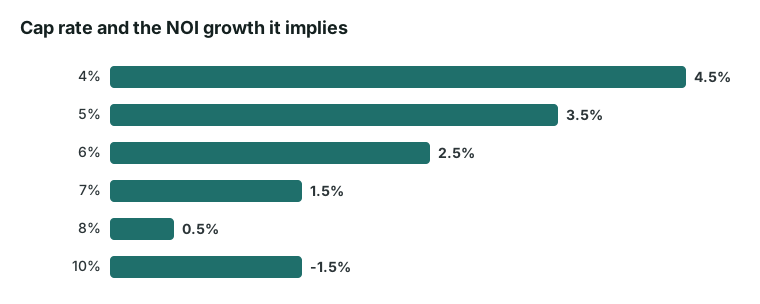
| Cap rate | Implied NOI growth |
|---|---|
| 4% | 4.5% |
| 5% | 3.5% |
| 6% | 2.5% |
| 7% | 1.5% |
| 8% | 0.5% |
| 10% | -1.5% |
The simple version on the calculator’s first tab, $30,000 of NOI on $500,000, is a 6% cap rate. Against an 8.5% discount rate that implies 2.5% growth, close to long-run inflation.
The table also explains high cap rates. A 10% cap rate does not mean a great deal. Against the same required return it implies NOI shrinking 1.5% a year, which is what buyers expect from a declining submarket, a short remaining lease or a building near the end of its useful life. Different investors plug in different discount rates, which is why investment value for one buyer rarely matches another’s.
Setting a terminal value at sale
Most investors do not hold forever, so they build a discounted cash flow model over five or ten years and cap the rest. The last line of that model is the terminal value, and it is pure Gordon growth.
Terminal value = NOI in the year after sale / exit cap rate
Grow the $28,892 NOI at 2.5% a year for five years and it reaches about $32,689. Divide by an exit cap rate and you get the sale price:
- 6% exit cap: about $544,800
- 6.5% exit cap: about $502,900
- 7% exit cap: about $467,000
Notice that five years of 2.5% growth only offsets about three quarters of a point of cap rate expansion. Then discount that figure back at your discount rate to get its present value. In a five-year model the terminal value usually carries a large share of the total answer, so the exit cap rate deserves as much attention as the rent roll.
When the perpetuity assumption breaks down
The formula needs g to be below r. If you plug in growth equal to or above your discount rate, the denominator hits zero or goes negative and the math returns nonsense or infinity. That is a signal your growth assumption is too aggressive, not a valuation.
The assumption also strains in these cases:
- Fixed or stepped leases. A lease with 2% annual bumps and no reset for 15 years is a bond, not a growing perpetuity. Value the lease term separately, then cap the reversion.
- Finite interests. A ground lease with 30 years left has an end date, so there is no perpetuity to capitalize.
- Lumpy capital spending. Roofs and HVAC systems do not arrive smoothly. Smooth NOI hides them, which is why reserves belong in the NOI, not in a footnote.
- Physical decline. Buildings age. Holding NOI growth above inflation forever assumes renovation spending that the model never shows.
- Volatile income. Short-term rentals and hotels swing with travel demand, so a constant growth rate describes very little about them.
Checking an exit cap rate against the model
Run the formula backward on any exit cap rate before you accept it. Subtract your assumed long-run growth from your discount rate and compare the answer to the exit cap rate in your model.
If your discount rate is 8.5% and you believe in 2% perpetual growth, the model points to a 6.5% exit cap rate. Using 5.5% instead means you expect the next buyer to accept 3% growth forever. Possible, but it should be a choice you can defend, not an inherited default.
A common convention is to set the exit cap rate at or slightly above the going-in cap rate, often by a quarter to a full point depending on the asset’s age and the length of the hold. The model tells you what that spread is really saying about growth.
Run the numbers
The Cap Rate Calculator on the home page gives you the cap rate, NOI and value at a target cap rate from your own inputs. Take the cap rate it returns, subtract it from your required return, and you have the growth rate your price assumes.

Frequently asked questions
What is the capitalization rate Gordon growth model?
It is the formula cap rate = discount rate minus growth. The Gordon growth model values a cash flow stream that grows at a constant rate forever as next year's cash flow divided by r minus g. Direct capitalization divides NOI by a cap rate. Set the two denominators equal and the cap rate is r minus g.
Can a cap rate be seen as a perpetual growth assumption?
Yes, in reverse. A cap rate is a required return with expected income growth already subtracted. If you need an 8.5% return and buy at a 5.78% cap rate, you have assumed net operating income grows about 2.7% a year forever. Lower cap rates always imply faster assumed growth, more risk, or both.
How is cap rate related to the discount rate?
The discount rate equals the cap rate plus growth. A cap rate is a first-year yield on price. A discount rate is the total annual return you need across the hold, including income growth and resale. The two match only when you expect NOI to stay flat forever, which is rare.
How do you use a cap rate in a DCF model?
A cap rate sets the terminal value. Project NOI through the hold, then divide the NOI in the year after sale by an exit cap rate to get the sale price. Discount that figure and the interim cash flows back at your discount rate. The exit cap rate is where most of the model's uncertainty sits.